-

By Randall C. Resch
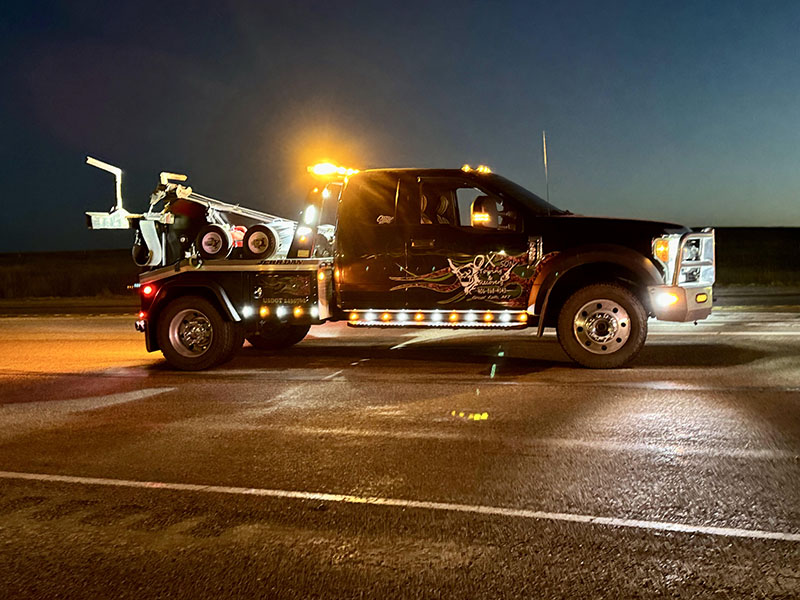
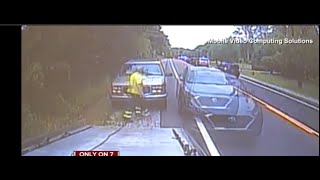
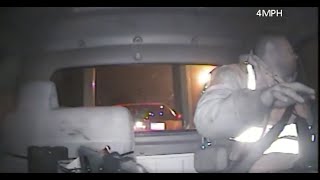
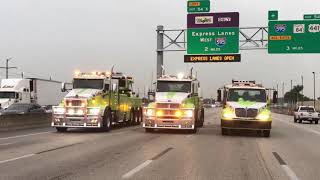
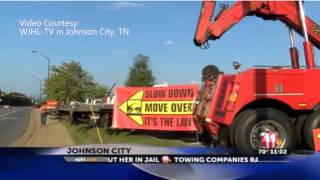
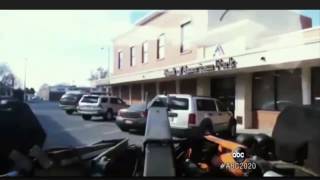
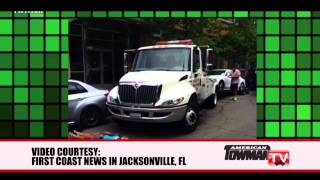
In June, a “driving in traffic” tow operator captured video of another wrecker towing a Toyota pickup at night, likely without keys for PPI or repossession.
The 23-second video depicts a light-duty wrecker towing the pickup “not following in the wrecker’s path,” traveling in the fast lane with its overhead amber lights activated, including all rear-facing work lights. The wrecker is traveling slower than traffic with no extension lights attached. Any problem?
Towers knowingly “risk being cited” by law enforcement for “shortcutting or ignoring” proper tie-down and transport safety, all because of complacency or laziness.
See No Evil
This disregard for “tow safety requirements” begs the question: “Do towers think highway patrol officers and troopers won’t enforce this action when violations exist?” For towers who know vehicle code law, if they can spot tow-related violations, so can law enforcement. They’re not the Tow Police; it’s reality and fact!
The video’s comments revealed that some towers “lacked safety sense.” One respondent commented, “I mean, I have done that before and I’ll do it again, looks just fine.” Eleven responding towers approved his words. Another tower wrote, “Steering is locked and no keys, looks good to me?” To my amazement, twenty-two other towers approved.
One comment reflected a careless operator mentality: “I don’t see anything wrong, that’s the tow life.” Are you kidding me? The comment that took the proverbial cake said, “I took one the other day, steering locked completely sideways, took the backroads all the way back to the yard.”
Cops Don’t Play
Let this narrative serve as “Mandatory Tow Basics 101.” Why? Because tow truckers actively violate vehicle code laws. There’s no denying that tow safety is disregarded every day.
It’s clear that catastrophic news events can result when towed vehicles disconnect from wreckers or when “a crab walking (towed) vehicle” plows into parked cars. For towers who follow daily news and industry forums, complacency, laziness, and flat-out disregard for “tow required safety compliance” are regular and consistent occurrences.
Here’s the Argument
Using California’s vehicle code as an example, any cop with hawk-like eyes and a penchant for traffic enforcement can issue citations when wreckers with towed cars “travel outside the wrecker’s path.” In most states, and as the video depicts, offending towers “could be cited” for violating multiple vehicle codes. Consider the following:
Straight Tracking: CVC 24009(a)(2) prohibits operating a train of vehicles when a towed vehicle “whips or swerves from side to side or fails to follow substantially in the path of the towing vehicle.”
Unsecured Load: CVC 24002(a) prohibits operating a vehicle that is in an unsafe condition or not safely loaded.
Towing Prohibited: CVC 21655 requires certain towing vehicles to use the designated right-hand lane or the next lane, except when overtaking.
Unsafe Movement: CVC 22107 prohibits moving right or left until the movement can be made with reasonable safety and, when necessary, with an appropriate signal.
Impeding Traffic: CVC 22400(a) prohibits driving so slowly as to impede or block the normal and reasonable movement of traffic unless the reduced speed is necessary for safe operation or required by law.
Safety Chains/Straps: CVC 29004(a)(2) requires a towed vehicle to be coupled by at least two safety chains in addition to the primary restraining system.
White Lights to the Rear: CVC 25110(a)(1) limits the use of utility flood and loading lights on tow trucks to the preparation for towing at the location from which the vehicle is to be towed.
Amber Lights: CVC 25268 prohibits displaying a flashing amber warning light except when an unusual traffic hazard exists.
Extension Lights: CVC 24605(a) addresses required lighting on vehicles extending beyond the rear.
Change Your Ways
Only two towers posted what could be considered “common sense responses.” One comment was spot-on: “Dollies take a lil’ sense, but saves a lot of dimes.”
Having retired as a traffic cop who’s written thousands of cites, I offer this simple narrative to plant seeds of “in-tow safety” among our readership. If you’re that tower thumbing your nose and “towing your way,” don’t say I didn’t warn ya’. The advice is free … use it wisely!
-
By Rich Holland
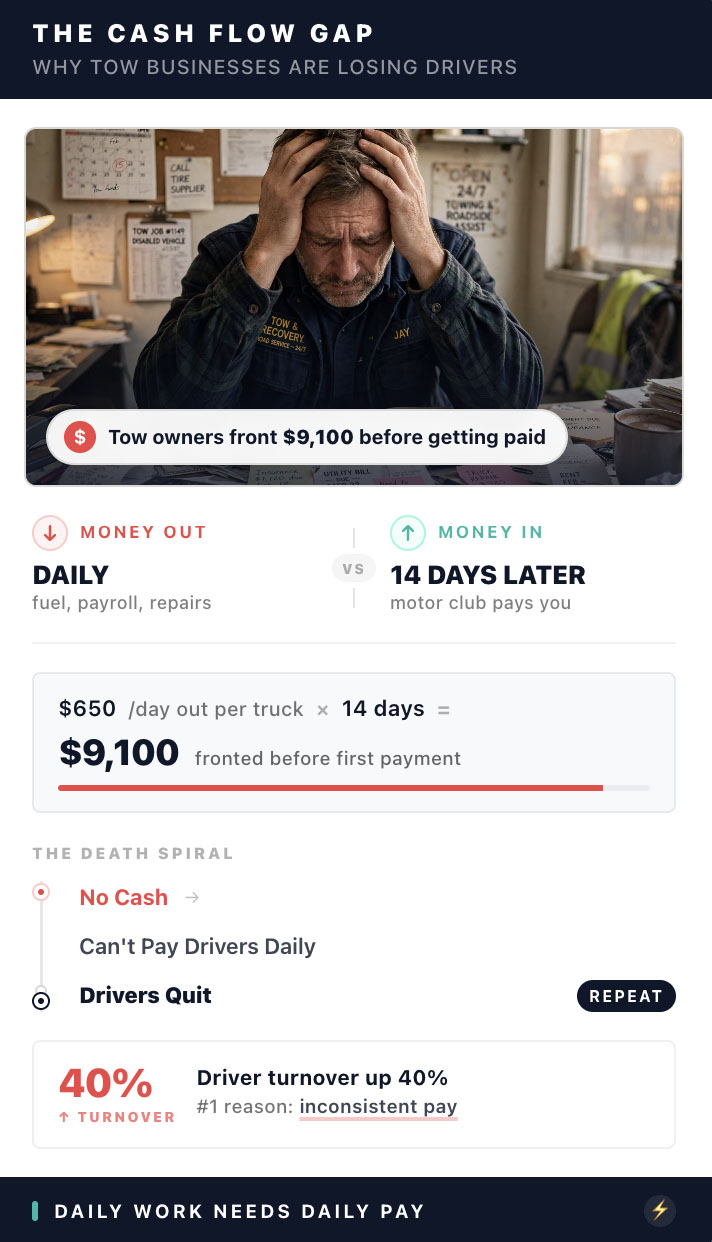
All roadside service providers know the math. They roll out at midnight, change a tire on the highway, run a lockout call in the rain, haul a sedan off the interstate. Typically, near the end of the work week, most tow operators have racked up fuel, equipment wear, and hours of labor. And then the wait begins, two weeks, more or less, for the check to show up.
This gap has become so deeply ingrained in the industry that most tow operators no longer recognize it as a deficiency. It has been accepted as the status quo. But that does not mean it’s acceptable, and it is certainly not effective.
Much of the towing and roadside service industry is built on independent operators and small fleets running on tight margins, carrying overhead costs that do not wait for payday. Fuel bills come due. A truck that needs a repair can’t always be postponed. The mismatch between daily costs and a delayed revenue stream is not just an inconvenience. For many owner/operators, it is a primary reason to hesitate before accepting additional dispatches, expanding network partnerships, or even continuing in the business altogether.
The Retention Problem
The roadside service sector has a well-documented driver retention problem. The issue usually involves wages and working conditions. All of this is real, but underneath, largely unexamined, is the financial dynamic: independent roadside service providers are running a daily-cost business on a bi-weekly (or longer) payment cycle.
An owner-operator takes dispatches, fulfills every call within spec, and builds the relationship. And for two weeks they float the costs out of their own pocket, relying on reserves or credit to cover the daily financial demands of the business.
For operators with strong cash reserves or access to a line of credit, this shortfall is manageable. For a significant portion of the industry, however, neither option is available. As a result, it creates a persistent low-grade financial strain that influences nearly every operational decision—which dispatches to prioritize, the provider relationships to invest in, and ultimately, even whether to remain in the game.
The bi-weekly standard was not intended to create this problem. It was just the way accounting systems worked when the industry built its payment infrastructure. The operational logic made sense in its era. While the era has changed, the standard has not.
What Tow Operators Actually Need
Ask any experienced roadside assistance provider what they want from a partner relationship and the answers are consistent: steady dispatch volume, fair compensation, technology that makes the job easier and, perhaps most critical, a payment schedule that reflects the day-to-day realities of running an operation, where costs hit every single day.
The financial relationship between motor clubs and their service provider networks is not merely an administrative detail; it serves as a meaningful indicator of how that partnership is valued. When a motor club pays providers directly and in a timely manner, it signals respect for the operator’s cash flow and operational demands.
The impact shows up in dispatch behavior. When two dispatch requests land at the same time, tow operators make a choice. That choice is shaped by which partner pays reliably, communicates clearly, and has demonstrated through actual behavior that it values the operator on the other end of the call. Payment speed stands as one of the most visible and consequential determinants in this dynamic.
Daily Pay - The Effects of a Simple Idea
The concept is straightforward. Pay drivers for completed work each and every day, rather than hold payment for two weeks.
Payment technology to support this is no longer the barrier to improving payment practices. Integrated roadside service platforms can connect dispatch management, service verification, invoicing, payment processing, and financial reconciliation into a single digital workflow.
Instead of relying on multiple manual handoffs between operations and accounting, each completed service event can move automatically from dispatch to payment eligibility. A provider accepts a dispatch digitally, updates arrival and completion statuses in real time, and submits supporting documentation through a mobile workflow. The system can then validate the work against agreed pricing and service requirements, allowing payment to be approved far more quickly than traditional batch-processing models.
What is currently lacking is the willingness to update payment practices to align with connected operational capabilities. When payment aligns with the actual rhythm of the business, the gap between cost and cash disappears. Credit lines stop absorbing two weeks of operational float. The owner-operator who was hesitant to take on more dispatches now has a reason to lean in.
Daily pay is not a loyalty incentive—it is a fundamental redesign of how the financial partnership works.
A motor club with a dense, loyal, financially stable service provider network can dispatch faster, cover more territory, and deliver more consistent service quality. The economics of driver retention and the economics of dispatch performance are the same, just viewed from different sides of the same coin.
What the Industry Should be Asking
The roadside service industry faces no shortage of challenges. The complexities of EVs are changing what roadside calls look like. Flatbed-only towing requirements and range-depletion calls are creating new demands on training and equipment. Driver recruitment is competing with industries that have invested heavily in benefits and working conditions.
Against that backdrop, the question of when drivers get paid can seem secondary. But it’s not. It is the financial foundation of every other decision.
Motor clubs and roadside administrators that want loyal, high-performing service provider networks need to examine whether their payment structures are built for the operators they want to attract, or for the accounting systems they built 20 or more years ago. These two are clearly not the same.
The roadside service industry runs on people who show up. Every dispatch, every midnight call, and every weather event that overwhelms the system can be impactful. The operators who keep showing up deserve a financial partnership built around the reality of their business.
Daily pay is a start. The broader conversation about what genuine motor club partnership looks like is long overdue.
Author bio: Rich Holland is the Chief Executive Officer of Nation Safe Drivers (NSD), a trusted provider of roadside assistance and vehicle protection solutions. Since joining NSD in the fall of 2023, Rich has focused on advancing technology-enabled services and strengthening partner-driven growth across automotive, RV, marine, and powersports markets. He brings decades of executive leadership experience across automotive technology, finance & insurance, and high-growth organizations.
-
By Randall C. Resch
A six-year tower wanted to be his company’s next supervisor, noting, “I’m the best candidate we’ve got for the position,” while describing his fellow drivers as “…a bunch of incompetent twits!”
He asked if I’d share some direct “pointers” on what it takes to be considered for a supervisory position. The company he worked for was considering hiring a driver manager, either from within or through an outside search.
Having worked for a competitor, I remembered him as a tower with better-than-average industry skills and one who always displayed a noticeable superiority complex. He was always ready to work and had all the equipment expected of him.
Compared to other drivers, I considered him “the exception to the rules.” He didn’t whine or complain, accepted every call assigned to him and eagerly worked past quitting time. His dispatchers loved him, and he was well-liked by the other drivers.
Although I considered him “ahead of the pack,” life was all about “him.”
Why Not Me?
As we talked, I heard his enthusiasm as he described the supervisor he’d likely become. He had ideas and visions for making the company better. His motivation was in line with a supervisory position—until he said, “The boss doesn’t freakin’ know what he’s talkin’ about!”
I felt that level of disdain could be hiding a dubious personality trait.
While I’m inclined to agree that some bosses don’t know what they’re talking about, some have still managed to build companies big enough to have employees and solid enough to stay in business. Somewhere within the boss’s “inability” to learn the industry’s nuts and bolts, he had managed some level of success running the company.
When I heard, “The boss doesn’t know what he’s talkin’ about,” I perceived an active ego that needed a lesson in reality.
So I asked if we could talk frankly about what steps might help his search. I thought I’d first address his attitude to see if that might stand in his way.
What I felt he didn’t understand was that, although his skills outpaced those of his peers, attempting to override the company owner or current management team wasn’t the path to making friends and influencing people.
Step one: “Dude, read the room and see whose name’s on the door.”
Hold the Door
I didn’t like the manner in which he rebelled against his boss’s way of doing things or the company’s rules.
I asked him, “Who are you to change the rules?” And, “What’s the possibility or potential that you’d even be considered?”
If “urge” was his driving force toward becoming a supervisor, wouldn’t becoming an owner better suit his ideas?
When considering a supervisory position, applicants have to have skills—and be skilled. Being a driver for five, ten or even fifteen years might make someone a great operator, but the responsibilities of a tow supervisor also include increased hours, interaction with employees, workload, stress and overload.
There’s so much more.
An all-around, all-inclusive supervisor should:
- Be a natural leader experienced in training and supervising others.
- Demonstrate the patience, tolerance and interpersonal skills necessary to deal with a multitude of personalities, abilities and attitudes.
- Effectively lead employees on a daily basis.
- Be experienced in handling damage claims, law enforcement contracts and all facets of business operations.
- Be ready to jump in a truck and handle calls when needed.
- Have the respect of peers and personnel.
The road to supervisor is a long process that typically comes with time and grade. When towers have abilities beyond their peers, some company owners recognize that experienced candidates have more to offer.
But all talk and no action ain’t impressive!
The ideal supervisor doesn’t hide behind a desk. It doesn’t work that way.
Humility Is Endearing
If a supervisory position isn’t openly discussed or advertised, ask the HR manager or owner for an informal sit-down. Bring a “neatly prepared resume” and humbly “sell the fact” that you’ve got something to offer.
Rest assured, a little well-emphasized ability is far different from arrogance and conceit.
Positive thinking helps demonstrate that you’re a qualified supervisor while continuing to build your industry skills. A complete resume makes for a better, well-rounded applicant. Sign up for supervisory courses and seek topic-specific industry training. Ask yourself: What makes you the better candidate?
Your work history should demonstrate the knowledge and experience needed to meet the company’s needs. And somewhere in that education and experience, an overactive ego may need to be tempered with humility.
At conversation’s end, I think he and I found some common ground. I told him that changing his attitude would better serve his chances of being selected.
I advised him to get humbled, stay motivated and not give up on himself.
I reminded him to be fully aware that it’s the boss’s name on the door, not his.
And yes, “boss is a four-letter word,” but it’s they who hold the proverbial keys.