-
By George L. Nitti
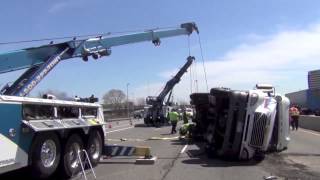
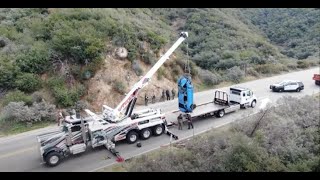
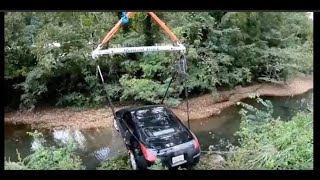
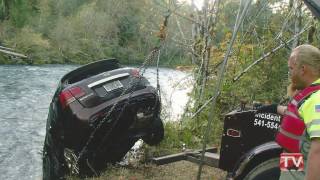
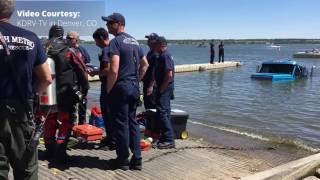
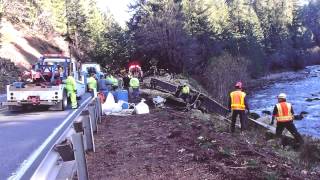
When a box truck went over a bridge and plunged approximately 80 feet into the water below, Roland Blais, owner of Blais Towing in Bedford, New Hampshire, was called to the scene.
“I heard it coming in on the scanner,” he said.
His company was one of roughly eight or nine towing operations on the rotation. When the call came, Blais knew his 35-ton wrecker wouldn't be enough, so he reached out to neighbor Precision Towing of Manchester for a 60-ton rotator mounted on a Peterbilt 389 chassis.
“I just got people to help me, and we help each other,” he said. “I called and they brought it out.”
Before a single outrigger was lowered, Blais knew there was another critical consideration: the bridge itself. Before entering the towing industry, he had worked in bridge construction, so he requested that bridge engineers inspect the setup.
“We didn't want to put too much weight on the bridge to crack something,” he said.
A state DOT foreman helped determine where the rotator could be positioned before bringing in a bridge engineer to make the final call.
“We were measuring where the beams were and cross members,” Blais said. “We set up, lowered everything down, and he came back. He goes, ‘Move the truck about eight inches.’”
The bridge was closed completely to traffic while engineers monitored the operation. The rotator was positioned 13 feet or more from the edge, forcing Blais to reach approximately 18 feet to the center of the truck below.
The recovery also required New Hampshire Fish and Game divers, fire departments from Bedford and Manchester, state highway personnel, police and bridge engineers.
Blais' son, Stephen, went down with the divers and directed the rigging operation from the water.
“I stayed up top,” Blais said. “My son was down there telling them where to go down and hook up the chains.”
The crew used two spreaders, 10-foot endless loops and eight-foot chains around the wheels to protect the slings from the damaged body. At the front, they used six-foot endless loops with eight-foot chains.
“We did everything as low as possible, so when we got to the top, we'd have enough room to clear the guardrails,” Blais said.
Then came the biggest unknown: the current.
The truck had landed in approximately 10 feet of water, roughly 80 feet below the bridge.
“The only thing that I was worried about was the current,” Blais said. “When I was picking up off the bottom, the current would take it under the bridge.”
There was no practical way to tie the vehicle off because of the bridge's width.
During the first lift, the truck began to move and rotate as it came off the river bottom.
“The first lift, it started to line itself, and the truck was going under the bridge,” Blais said. “I set it back down. I looked at it. I said, ‘No, we're just spinning.’”
His son, watching from below, had a different interpretation.
“He goes, ‘Well, it ain't going under the bridge, it's just lining itself up with the bridge.’”
That was enough to proceed.
On the second lift, the crew brought the rear of the truck out of the water and allowed the water to drain before continuing with the front.
“We got the back end out, all the water out, and then we lifted the front,” Blais said.
Once the truck was out of the water, the recovery became more predictable. Blais stopped the lift while state personnel managed traffic and monitored the bridge.
“We let the state do what they wanted to do on top, get rid of all the traffic and weight, so we could see what the bridge was going to do while we're lifting it.”
The rigging performed as planned.
“We had enough height. We cleared the guardrail by about two feet.”
One chain tore through part of the truck's body during the recovery, but Blais wasn't concerned.
“It was nothing to worry about,” he said. “That's why we used the chains, so we wouldn't cut nothing. Nothing really was rubbing. Everything was good, perfect.”
Once the truck was back on the bridge, the rest was comparatively easy.
“I knew we had it made,” Blais said. “Everything went smooth from there on. It came right up because there was no more weight. The water was gone.”
The driveshaft was removed, the truck was hooked up and it was towed away without requiring a trailer.
From the initial phone call until Blais returned to his shop, approximately seven hours had passed. The actual lift took about an hour, with roughly 45 minutes spent getting the truck rigged.
But the recovery was more than a towing operation. It was a coordinated effort involving multiple agencies and towing companies. Precision Towing supplied the 60-ton rotator, while Fish and Game provided the divers. Firefighters assistedwith personnel and water operations, while police, highway personnel and bridge engineers helped manage the scene and ensure the bridge could safely support the recovery.
Blais was quick to credit everyone involved.
“I say thank you to all the people that helped us,” he said.
And then there was the family.
“There was me, my son, Stephen, who ran the hooking-up part,” Blais said. “The diver was down at the bottom. And my grandson Nicholas was on a tagline. So we had three generations out there.”
After decades in the towing business, Blais knows jobs like this are rarely accomplished by one person—or even one company.
“You can't do it alone,” he said. “You just gotta remember, you can't do it alone. There's always somebody out there to help if you got any questions.”
-
By George L. Nitti
For Jesse Giza, owner of Diversified Towing, which is located in several locations South Central Iowa, a difficult recovery is not necessarily about how much equipment can be brought to the scene. It is about determining what that equipment can accomplish, and finding a solution that gets the job done without creating additional problems.
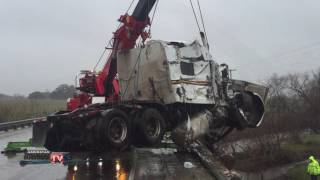
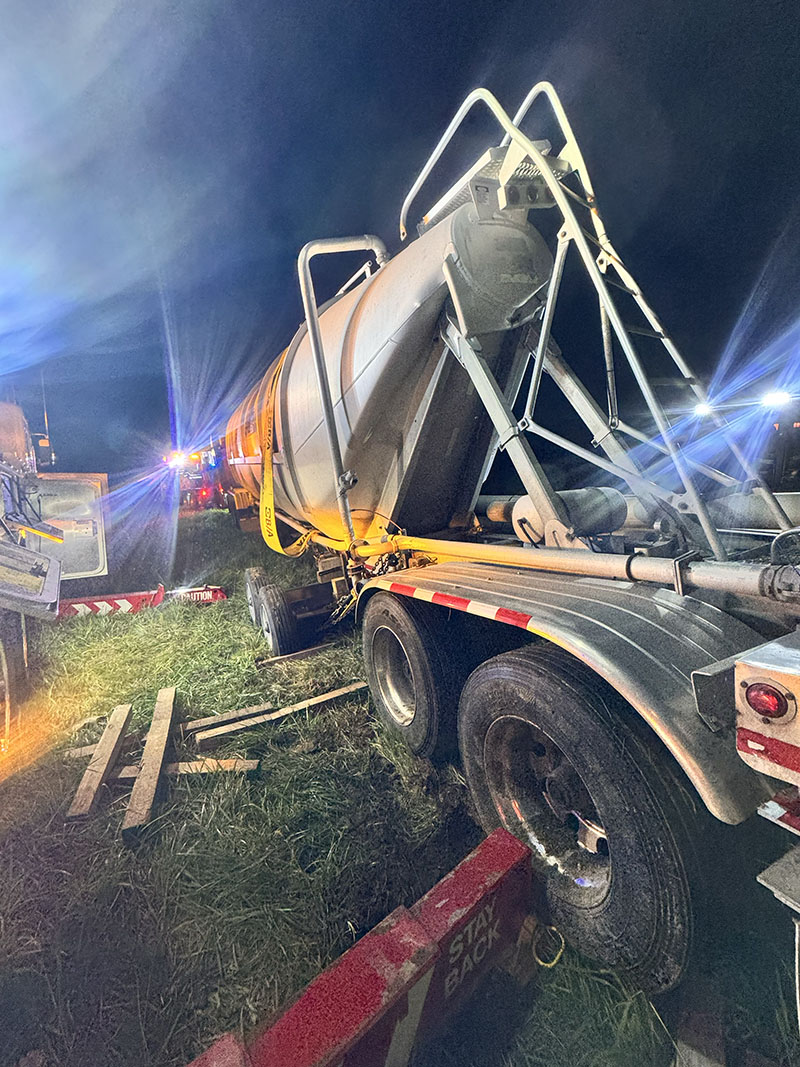
That philosophy was put to the test recently when Diversified was called to an interstate recovery involving a pneumatic trailer carrying approximately 44,000 pounds of food-grade salt.
The trailer had left the roadway and gone over a culvert. Its aluminum structure was badly compromised, particularly around the driver's side and axle area, leaving part of the trailer on the ground. The axles were also twisted, making it impossible to simply hook onto the trailer and tow it away.
The obvious solution—unloading 44,000 pounds of salt—would have created an entirely different problem.
"To me, it's a different recovery than a lot of people will get," Giza said. "It's not just a regular rollover where, oh, we rolled over and we lifted it up."
A two-stage recovery
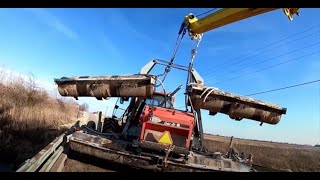
Diversified first used a 2020 Peterbilt 389 equipped with a Vulcan V100 50-ton wrecker to winch the trailer closer to the roadway.
The trailer was sitting over a culvert, and its compromised aluminum structure could not withstand being dragged down the roadway in its damaged condition. Once it was positioned where the crew could safely work, Diversified brought in a 2019 Peterbilt 389 equipped with a Miller 1150 rotator.
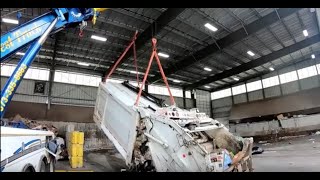
The rotator lifted the rear of the trailer while the crew positioned Big D Fabrication dollies underneath it. A skid loader equipped with pallet forks helped maneuver the dollies into position.
The dollies distributed the weight and allowed the crew to stabilize and move the damaged trailer without unloading its cargo. Chains and blocking were used to secure the trailer and keep the dollies in position while it remained connected to the recovery units.
"We did not want to unload that full load of salt in the middle of the road," Giza said.
The decision also preserved the possibility of salvaging the cargo. The trailer's seals had remained intact, and the load had not been compromised.
Although the customer ultimately decided to dispose of the salt, the recovery plan initially kept that option open.
Getting it off the highway
For Giza, minimizing the time a recovery crew spends alongside an interstate is a critical part of the job.
"We want to be off the road as quickly as we possibly can," he said.
Rather than spending additional hours unloading 44,000 pounds of salt beside the highway, the Diversified crew secured the damaged trailer and transported it to a tow yard, where the remaining work could be performed in a safer environment.
"If we can have a solution and not have to be out there for six hours doing a cleanup, our goal is to get it back to a secure yard to where then we can worry about the load," Giza said.
The approach can also help control costs. Giza, who previously operated his own trucking business, said he views a recovery from the customer's perspective.
"As an owner, I look at every job as like I'm the owner of that truck," he said. "How would I want the tow company to work for me to mitigate costs?"
In this case, that meant bringing the right equipment to the scene, stabilizing a badly damaged trailer and finding a way to move it without first turning 44,000 pounds of salt into another roadside problem.
-
By George L. Nitti
On a remote stretch of interstate outside Elko, Nevada, a young recovery crew proved that adaptability can be as essential to a recovery as equipment and experience.
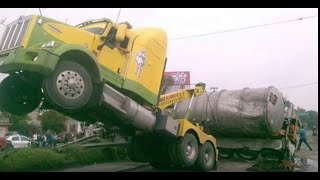
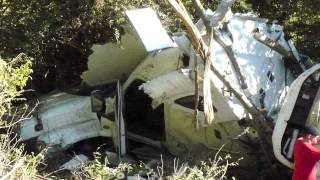
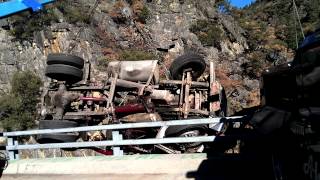
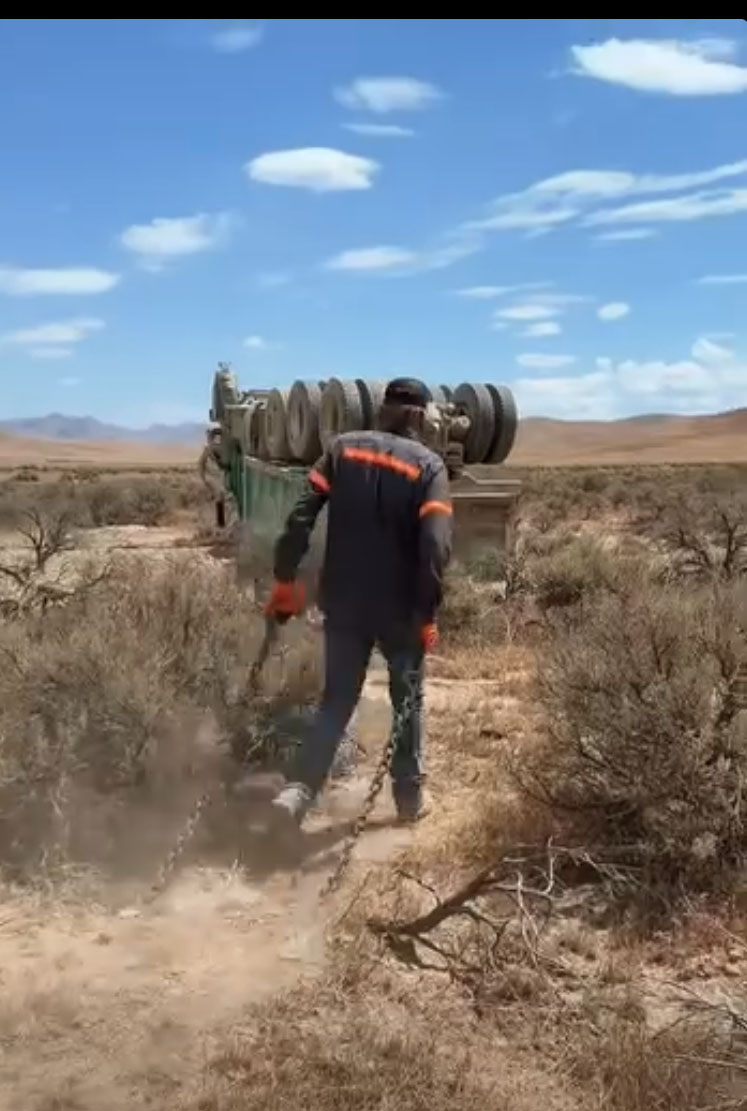
When a loaded mining dump truck blew a steer tire, the driver lost control and the truck overturned, coming to rest on its roof. The load spilled out, and much of the cab was crushed beneath the truck.
The call went to Atlas Towing & Recovery, where 22-year-old operator Blake Taylor responded in a 2018 Peterbilt 389 equipped with a Jerr-Dan 35-ton wrecker.
"There was really no traffic control when we got there," Taylor recalled. "I wasn't going to put my guys out on the interstate, so I had to find another way."
Rather than position the wrecker alongside the wreck, Taylor backed into a roadside ditch, clearing sagebrush and rocks to create a workable position. Even then, the wrecker could not get close to the overturned truck. Taylor had to run nearly 50 feet of wire rope to reach it, making both the rigging and the recovery more challenging.
His initial plan was to rotate the dump truck onto its side and then upright it. But with the available attachment points limited to the upper frame rails, the truck wanted to roll rather than rotate.
"If it had come over where I had it rigged, it would have landed on my winch line," Taylor said. "That could have shock-loaded the cable, and things could have gone wrong really fast."
Taylor made a second attempt using a synthetic sling beneath the wreck, but quickly abandoned that approach.
"There was too much torn metal hanging underneath. I knew I was going to cut the sling."
After nearly an hour of re-rigging and reassessing the situation, Taylor changed tactics. Rather than trying to rotate the truck first, he placed two winch lines on the backside and attempted to roll the dump truck directly where it lay.
The move worked better than expected.
"It flipped once, flipped again in the same motion, and landed right back on its wheels. It was pretty mind-blowing how smoothly it happened."
With the dump truck upright, Taylor repositioned his wrecker onto the interstate, winched the truck onto the roadway and hooked it for the tow back to Atlas Towing & Recovery's yard in downtown Elko.
The cab had sustained extensive damage, particularly on the passenger side, but the dump body and frame remained intact. The truck also retained air pressure, allowing Taylor to tow it without having to deal with additional complications.
Recoveries involving mining equipment are common for work for Atlas Towing & Recovery, which operates in one of Nevada's major gold-producing regions.
Owner Jeremy Muth purchased the company with his wife, Christy, in 2020. Since then, the operation has grown into a full-service heavy-duty fleet with three heavy wreckers, four medium-duty trucks and four equipment-hauling power units. The company also maintains loaders, skid steers, forklifts, slide axles, dry vans and its own traffic-control equipment.
"When we go to a wreck scene, we want everything we need with us," Muth said. "We don't want to depend on anybody else."
That self-sufficiency is particularly valuable in the rugged country surrounding Elko. Atlas regularly handles loaded ore-hauling combinations weighing more than 200,000 pounds over mountain passes. Elko sits at approximately 5,000 feet in elevation, and the high-desert climate can bring temperatures above 100 degrees in summer and well below zero in winter.
"Our recoveries are rarely simple," Muth said. "The terrain, the weather, and the weights make every job different."
Taylor knows that firsthand. He was introduced to towing at 16 and earned his CDL after graduating high school. Now, at 22, he is part of a young Atlas crew that Muth says routinely handles work well beyond what might be expected of operators their age.
For Taylor, the overturned dump truck demonstrated that even a relatively straightforward recovery can change quickly. The key, he said, is knowing when to stop forcing a \plan that isn't working.
"Sometimes you have to stop, rethink the rigging, and find the safest way to get the job done."